
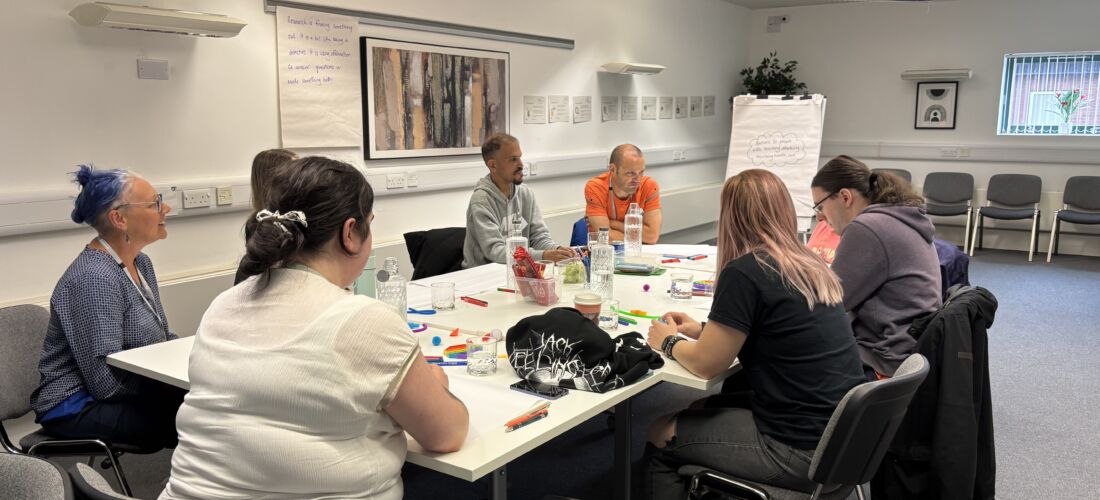
As part of safeguarding Adults Week, we shining a spotlight on a theme that sits right in the heart of everything we do at People First: Co-production.
When it comes to keeping people safe and well, you can't design real, lasting solutions for communities without building them with the people who actually live in them. true co-productions means sharing power, valuing lived experience just as much as professional expertise, and making sure every voice shapes what happens next. That's why we're proud to share an update from our Community Change Lab, a project that puts co-production into action every single day.
What is a Community Change Lab?
A Community Change Lab is a co-research centre where people with experience of learning disability, neurodiversity, service design and research work together in co-research. Co-research is when people with lived experience do research with researchers. Co-research is an equal partnership. People do what they are able to and what they enjoy – no one has to take part in everything. Co-research can use any tools and techniques and its focus is making people’s lives better.
Why Co-Research Matters
- About 2.5% of the population have a learning disability, but only 1.4% of academic grants are spent on research about learning disability.
- Despite a push for inclusion, populations with learning disabilities remain heavily underrepresented in research, for example, less than 1% of medical trials include people with learning disabilities, despite them experiencing a significantly higher prevalence of many conditions.
- People with learning disabilities have lives 19 years shorter than the rest of the population and 38% of their deaths are avoidable. This highlights the need for more research into the inequalities they experience, and people with learning disabilities are best placed to design and do this research.
- A review of health and social care research that included people with learning disabilities found only 17 papers written in the UK since 2000 and they only involved people with learning disabilities in the design process, they did not do the research themselves.
- We believe that with the right training and support people with learning disabilities and other needs can design, conduct, analyse, write up and communicate research themselves. There are no excuses for not involving people with lived experience as co-researcher.
Project One: Create accessible research training materials
In July 2026 the CCL won two grants from the National Institute for Health and Social Care. One grant enabled us to spend 30 hours together designing a set of accessible research training materials. We think these are important to ensure everyone can do research themselves.
You can access the research training materials and our evaluation of the project below:
Project Two: Are reasonable adjustments are in place in health care for people with learning disabilities?
The second grant has allowed us to do our first research project exploring whether reasonable adjustments are in place in health care for people with learning disabilities.
The co-research team chose the question and designed the research project. We designed a survey for health professionals and got 53 responses. We also wanted to hear from people with experience of learning disabilities and we did 14 interviews, held a focus group with 8 people and used creative methods with 8 people. We are still analysing the results, but it is already clear that whilst healthcare professionals may know about reasonable adjustments they do offer them and people with learning disabilities do not experience them in practice.
Everyone who took part gave ideas about what would make healthcare better.
Check in on our website in the new year to access the findings.
We hope our research project has shown how much can be achieved in co-research and our accessible research training materials help you to do co-research yourselves, making the world more equitable for everyone.