
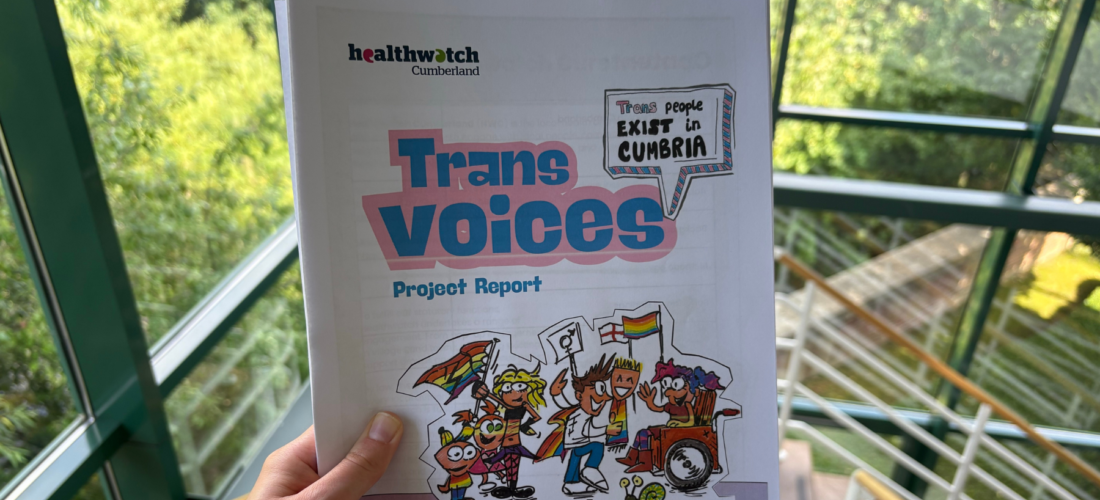
Trans and gender diverse people living in the UK often experience barriers when accessing health and care support. From long waiting lists for gender dysphoria* treatment, to hostility and a Supreme Court Ruling in April 2025, the Trans Community have faced increasing challenges. Healthwatch Cumberland decided it was an important time to capture the thoughts and feelings of those affected, and to find out what could be done better to improve care and support.
“Trans and gender diverse people are facing more and more challenges. From stigma to a lack of care and an ever-growing mental health crisis, the Healthwatch Cumberland team decided it was time to act. We all have a responsibility to support others and to speak up for those who are being treated unfairly. Trans people are often excluded from healthcare campaigns and discussions. It's time to change this.”
-Suzannah Brookes, Co-Project Lead
Between summer 2025 and early 2026, the Healthwatch Cumberland team carried out a project aimed at finding out what trans and gender diverse people think about living in Cumberland and accessing health and care services.
Our Trans Voices project involved a survey, case studies and a series of focus groups with some local peer support organisations. We were able to find out some deeply distressing truths about care. Some people have been on waiting lists for support for almost a decade, and when they do get gender dysphoria support it is primarily based in the North East of the country. Many people said they had experienced low mood and anxiety because of this.
How you can support trans and gender diverse people
Our project revealed some key findings and recommendations for local services and organisations which are explored in detail in our Trans Voices project report.
If you are a member of a local organisation or service who works with members of the public, we strongly recommend that you take some time to read our report to gain a deeper understanding of the thoughts and feelings that trans and gender diverse people might have upon receiving support from you or your colleagues.
If you work for an education provider, we also encourage you to read our report and find out the thoughts of your students on inclusivity and what changes they would like to see.
Members of the public are also encouraged to read our report. Even if you do not know a trans or gender diverse person personally, awareness plays a very important part in making spaces feel more inclusive.
Ways to be a more supportive ally:
An ally is someone who doesn’t belong to a certain group but is willing to support others who are in this group to feel accepted and safe. Being an ally to a trans or gender diverse person means you are willing to build your awareness and offer support. This support can look different depending on the circumstances of the situation, but here are some general tips for being a more gender inclusive ally:
- Don’t assume other people’s pronouns. It is better to use the pronouns they/them if you are unsure.
- Listen to and respect the thoughts and experiences of gender diverse and trans people, recognising that their feelings matter.
- Be aware that not everyone feels comfortable explaining their gender identity, and that people’s feelings around their own gender identity can change.
- Offer to be a listening ear if someone is struggling due to gender dysphoria or is experiencing mistreatment due to their gender identity.
Recommendations for healthcare staff:
If you work in a healthcare setting, it is important to make sure you build your awareness so that you can deliver more inclusive care to patients.
- Speak to your manager about receiving some staff training.
- Ask patients if you have the correct name and pronouns down on your system. This can be as simple as asking “what do you prefer to be called?”
We received a lot of feedback during this project about blood tests for hormone levels, and were concerned to hear that many GP surgery’s have refused to do blood tests for trans patients taking hormone treatments which were not purchased through the NHS. This can be very dangerous. Hormone levels need to be monitored when taking hormone medication, as unhealthy fluctuations can lead to complications such as blood clots. With waiting lists for treatment being up to around 10 years, many trans people resort to sourcing ‘DIY’ medication online, which can mean dosage is not regulated properly. We strongly recommend that any GP supporting a trans patient makes sure to check that their patient is receiving regular blood tests.
For more recommendations and findings, read our full Trans Voices report.
(Gender dysphoria: the feeling of being deeply unhappy with or disconnected from the gender that you were born with, or assigned at birth)